A power mean of order of a set of values  is defined by the following expression:
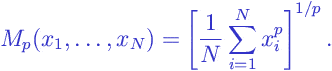
The family of power mean statistics is often called the generalized mean – because, for different values of the parameter , it is equivalent to various types of descriptive statistics: (i.e when  ) coincides with the arithmetic mean;
  is the harmonic mean;
  is the root mean square.
The greater the parameter , the greater the contribution of the largest values towards the values of  . If we increase infinitely, the value of the power mean approaches the maximum value in the sample , and the reverse – if we decrease
  infinitely, then the value of the power mean approaches the minimum value in the sample. This is often denoted as

and

Strictly speaking, is not the arithmetic mean – because this statistic is defined only for non-negative values , while the arithmetic mean is defined for both negative and non-negative values ).
The power mean is not a “fair” measure of central location – it does not meet requirements of shift invariance, like other statistics defined only for non-negative values (see explanations of central tendency). Therefore, it would be more correct to classify the power mean as a measure of “average magnitude” or “effective magnitude”. Any power mean is scale-invariant.
See also Mean values (comparison) and the online short course Basic Concepts in Probability and Statistics