Harmonic mean is a measure of central location. The harmonic mean of positive values is defined by the formula
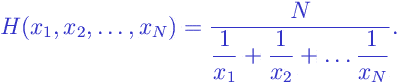
Let the path between two cities and  be divided into parts of equal length. One drives the th part at velocity . Then, the average speed on the whole journey is the harmonic mean of velocities .
The harmonic mean is sensitive to a single small value – tends to be small if at least one of the values is abnormally small. (In the above example, this corresponds to very slow driving through one of the road parts, leading you to spend most of the journey on this part of the path).
For this reason, the harmonic mean is often used, for example, to aggregate scores in different types of activity to a single final score, e.g. to estimate students’ performance. This ensure that no partial scores are radically lower than the final score.
See also Mean values (comparison).