A linear filter is the filter whose output is a linear function of the input. Any output value of a linear filter is the weighted mean of input values. In other words, to form one element of the output at time , it is necessary to multiply the input values for time moments adjacent to by coefficients and to sum up the products.
Mathematically, the output of a linear filter may be described by the expression
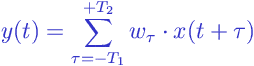
where
- is the output of the filter (the result of filtering);
- is the input of the filter (the original time series to be filtered);
 is the size of the “window” of the filter – the number of the input values affecting one output value;
 are “weights” that completely describe any linear filter.
In contrast to nonlinear filter, there is a well developed and conceptually rich mathematical theory of linear filters.
All the linear filters are subdivided into two broad categories – nonrecursive filters and recursive filters.
Examples of a linear filters are: the rectangular filter, the triangular filter, the Gaussian filter, the exponential filter, Kalman filter.