The exponential filter is the simplest linear recursive filter. Exponential filters are widely used in time series analysis, especially for forecasting time series (see the short course Time Series Forecasting).
The exponential filter is described by the following expression:

where
- is the output of the filter at time moment ;
- is the output of the filter at the previous time moment
 ;
; - is the input of the filter;
 is the parameter of the filter.
In simple words, the output of the exponential filter is the weighted sum of the previous output (taken with weight  ) and the current input value (taken with weight ). The smaller the parameter , the longer the “memory” of the exponential filter and the greater the degree of smoothing.
The term “exponential” stems from the fact that, if to try to realize an equivalent nonrecursivefilter , then the weights  , defining the contribution of the input values to the output , decline exponentially with . The “exponential” here means that each previous input value
 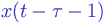 contributes times smaller to the output than .
This exponential character of the decline of weights means that, if to try to implement an equivalent filter as a nonrecursive filter, then an infinite number of preceding input values should be taken into account (and this is, strictly speaking, computationally impossible). This feature illustrates a major advantage of recursive filters over nonrecursive filters – computational simplicity.