The autoregression and moving average (ARMA) models are used in time series analysis to describe stationary time series. These models represent time series that are generated by passing white noise through a recursive and through a nonrecursive linear filter, consecutively . In other words, the ARMA model is a combination of an autoregressive (AR) model and a moving average (MA) model.
The order of the ARMA model in discrete time is described by two integers  , that are the orders of the AR- and MA- parts, respectively. The general expression for an ARMA-process is the following:

where
- is the order of the AR-part of the ARMA model;
- are the coefficients of the AR-part of the model (of the recursive linear filter);
- is the order of the MA-part of the ARMA model;
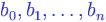 are the coefficients of the MA-part of the model (of the non-recursive linear filter);
- are elements of the (input) white noise;
- are output uncorrelated errors.
The ARMA model, for example, is used to construct the ARIMA model of nonstationary time series.