Shift invariance is a property of descriptive statistics. If a statistic is shift-invariant, it possesses the following property for any data set :

or, in equivalent form

In other words, if a statistic is shift-invariant, then addition of an arbitrary value , positive or negative, to all elements of the sample results in the increase/decrease of S by the same amount .
Measures of central location – like the mean, the median, the trimmed mean, the mode, the weighted mean – are shift invariant.
Shift invariance is an important requirement imposed on many classes of statistical measures, e.g. measures of central tendency and measures of dispersion. If the beginning of the scale used to measure the primary data is quite arbitrary (e.g. time, or a spatial coordinate), then it is strongly recommended to use only shift-invariant measures.
For example, consider values of the difference between a reference price of a particular car model (e.g. the suggested retail price of that car model) and the actual sale prices of this model for 1000 recent sales across the country. The question of interest is the typical value of the price differences .
Suppose a researcher has chosen a measure of central tendency (like the trimmed mean or mode), calculated its value  for the data at hand, and obtained the following result:
  (dollars) – i.e. price is higher than the prices at other dealers by a typical value of 500 dollars. The owner decides to set a new price
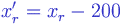
  , say, 200 dollars lower (
  , or
, or  ). What about the value of now? There are two reasonable methods to calculate the value of statistic for new data :
(i) Subtract 200 (dollars) from each price difference: 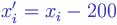 and, then, compute the new value
  of statistic for these new data :

(ii) Subtract 200 (dollars) from the old value of i.e.  .
.
For a measure that is shift invariant, the result in both cases is always the same – i.e. for any data set and any value of the shift .
A general practical recommendation: if the data at hand are measured on a scale with the zero point chosen quite arbitrarily (normally such data may take on both negative and positive values), and the quantity of interest is expressed in the same units as the data themselves, then it is preferable to use statistics that are shift invariant.