The basic mathematics behind the idea of Kalman filter may be described as follows – Consider, for example, a Markov chain – i.e. a random series with Markov property – described by the following equation:
 | (1) |
where
- – is the value of the vector-values Markov chain
 at the moment
  of discrete time
  ;
; - is a known matrix which describes regular causal link between the current state and the next state
 ;
;  is a zero-mean random noise with known covariance matrix.
The Kalman filter for time series specified by equation (1) may be described by the following recursive expression:
 | (2) |
where
 is the output of the Kalman filter, which is normally used as a predictor for
  ;
;- is the “Kalman gain”.
The expression (2) is only one of several mathematically- equivalent forms. It shows that the Kalman filter output  is a sum of two terms. The first term (
  ) is a dynamic prognosis based on the known transition matrix of the Markov chain (1) ; the second term is a linear function of the prediction error (
  ) from the previous step.
The theory of Kalman filtering specifies expressions for calculation of the optimal matrix in equation (2) from the known covariance matrix  of the random vector
  in the model (1) .
Besides the simplest case described by (1-2) , the classical theory of Kalman filters covers more complex settings, e.g. when the state vector is not observable – i.e. only a linear function  of is known
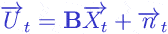
where
 is a known matrix;
 is the observation noise with known covariance matrix.
There are also generalizations of the Kalman filter theory for continuous time , expressed in terms of differential equations (not difference equations, like above); and there are extensions to non-linear filtering.